
AFREJ Year in Review
The Acting for Racial and Economic Justice Committee (AFREJ) organizes our membership to support local racial justice, environmental justice, labor and immigrant struggles.
Last month, several of us attended the Celebration for Grassroots Organizing, an amazing annual event where we got to share a meal and help raise funds for organizations like Families For Justice As Healing, the Muslim Justice League, Alternative For Community and Environment, and others whose work we have been supporting in AFREJ. We left the event incredibly inspired and hope we can share some of the inspiration with you in recapping what we’ve done this past year and where our fight for racial and economic justice has taken us.
We have focused on 3 areas in the past year, all of which, for us, fall within a reparations framework that aims toward a guarantee of non-repeat of systemic institutionalized oppression. We have participated in local racial and economic justice campaigns, local and national reparations campaigns, and local abolition campaigns. We have continued to support the Solidarity Economy ecosystem in MA that we began supporting in 2021 by co-hosting workshops/fundraisers for the Boston Ujima Project. We also support all the AMAZING work that the BWC I/P committee has been doing to stop the war in Gaza.
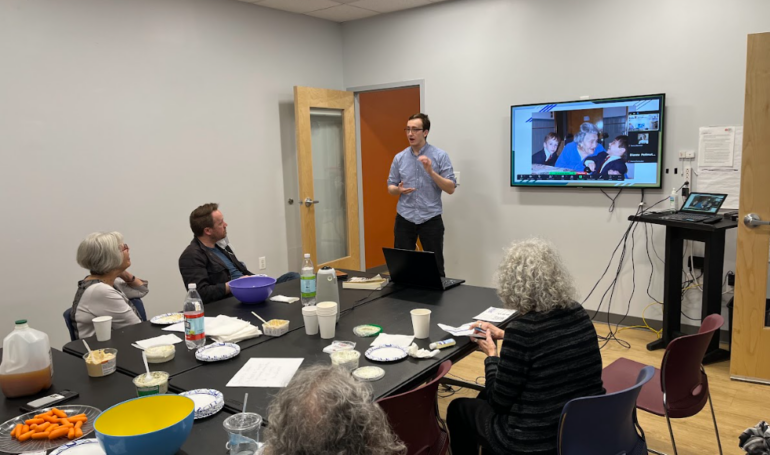
Much of our work happens within coalitions because we know it takes community, solidarity, and strength in numbers to achieve collective liberation for all. In September, we hosted Andrew Steinberg, an organizer from the Jewish Alliance for Law and Social Action (JALSA), who filled us in on JALSA’s legislative priorities for the year and engaged us in actions focused on racial and economic justice bills on the docket in the state legislature. In November, we built on the previous year’s Learning for Action series by joining in coalition with Marlon Solomon of Afrimerican Academy, the Forum for Racial Equity and Justice, and the Hyde Park Community Input Board to host a walking tour to learn more about the place-based history of redlining in Dorchester. With guidance from well-known community organizer and founder of the Massachusetts Communities Action Network, Lew Finfer, we got to see some of the sites central to Jewish life in the 40s, 50s, and 60s before Jews fled amid a toxic mixture of racist housing policies, blockbusting, and anti-Black racism. Throughout the year we have continued to support the Housing Justice Campaign of the Greater Boston Interfaith Organization (GBIO) which culminated in more than 1,700 community members and dozens of advocacy organizations coming together to fight for housing justice. Thanks are due to Maya Margolis for liaising between AFREJ and GBIO. The campaign is ongoing and help is still needed to continue to advocate for the Real Estate Transfer Fee (RETF).
At the end of March, we hosted Building a World Beyond Capitalism: BWC Members in the Solidarity Economy. In this program, 8 BWC members active in various Solidarity Economy initiatives across the state shared their experience working on various aspects of Solidarity Economy, from worker, housing, and food co-ops to movements for participatory budgeting in Boston, and more. For those of you who could not attend or who want to review the projects and insights offered by our amazing speakers, you can find a recording here (Passcode is !afrej327).
We have also worked with Families for Justice as Healing (FJAH) and Building Up People Not Prisons (BUPNP), organizations that work together to provide support for incarcerated women, including on efforts to secure their release and to accompany them on returning to their communities. It is inspiring to learn from them about repair and responsibility, undertaken even as incarceration impedes those efforts. A current focus has been on legislatively supporting elder parole, stopping the construction of a new women’s prison, and imposing a moratorium on any new prison construction.
In May, several of us from BWC walked together in the Mother’s Day Walk for Peace. Hosted by The Louis D. Brown Peace Institute, this annual event is a wonderful time to hear from community leaders and politicians who recognize the importance of investing in community resources to fight gun violence as well as walking in solidarity with those who have lost loved ones. Thanks to the continued efforts of BWC member Ann McHugh, we doubled our fundraising goal and raised over $3,600 for the Peace Institute.
Our work as a founding member of the Reparations Interfaith Coalition has continued to grow since last December when we brought together 275 people from communities, congregations, and organizations across Massachusetts for a reparations gathering titled Call to Repair: Justice, Healing, and Reparations in MA. As a result, approximately 140 of the participants are now on a mailing list that has enabled us to put out calls to action on reparations throughout the state. Most recently we have been advocating for Senate Bill 1053, a bill to establish a reparations commission in MA. In addition to calling and writing to our representatives we went to the State House to offer testimony, in coalition and with guidance from the MA Black Reparations Collective.We hope to bring more BWC members into this coalitional solidarity work, as ways of building relationships that sustain the energy and the hope needed for the long-term struggles of tikkun olam. We aim to ensure that all of the work we’ve done this year is ongoing, and we will also be focusing our attention on how to counter the very real threats to any and all organizing for racial and economic justice.
We hope you will join us in this work, and we’d love to hear from you! You can contact us at afrej@circleboston.org.
Lynne, Naomi, and Nakhie